
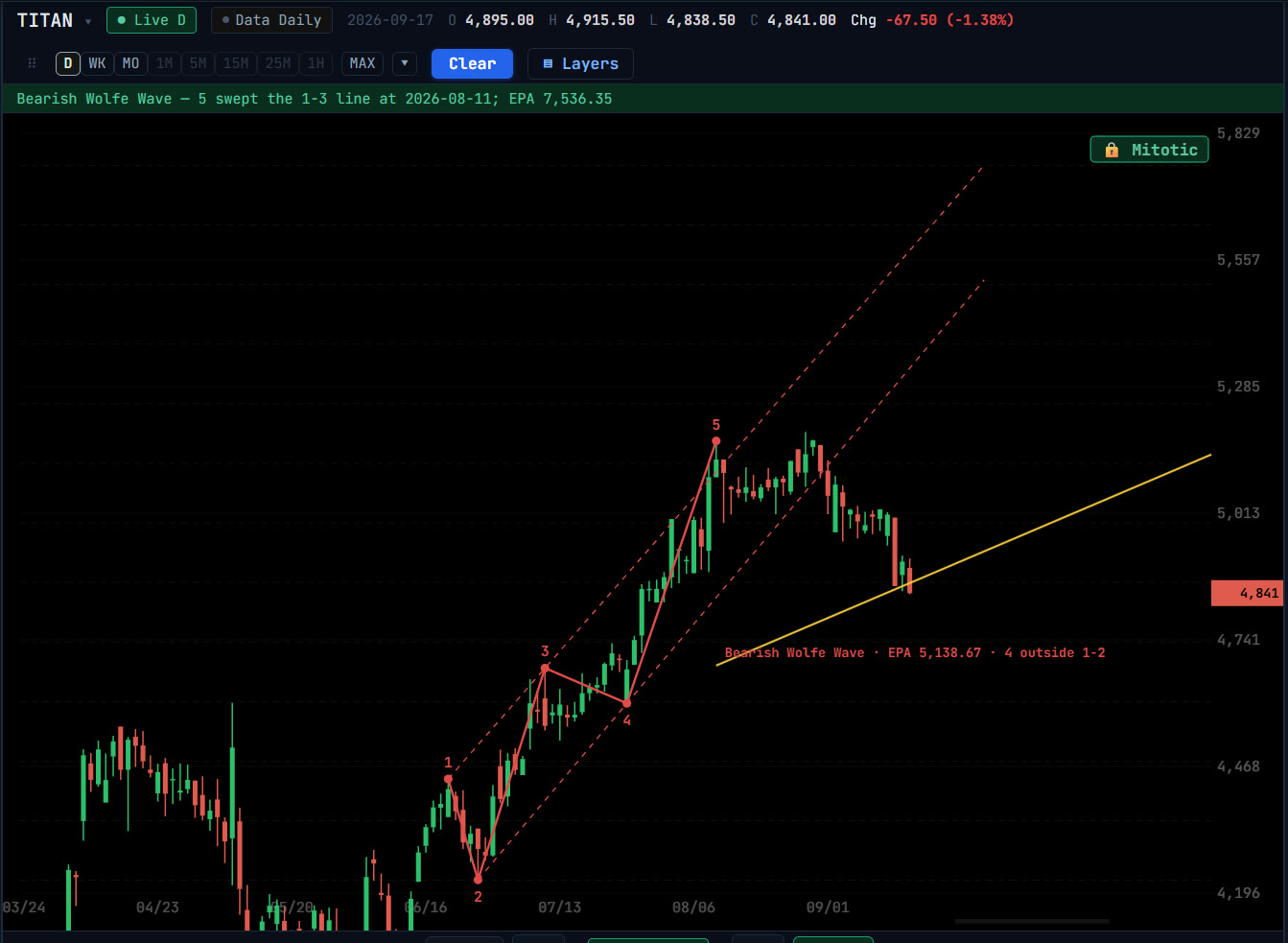
The pattern
A Wolfe Wave is five alternating swings in which the 1-3 and 2-4 lines converge. Wave 5 sweeps through the 1-3 line, like a spring being wound, and price is then expected to travel to the line drawn from 1 through 4. A falling wedge with declining lows at 1, 3 and 5 is bullish; the rising mirror is bearish.
Reading it on the chart
- EPA line (yellow)
- The 1-4 line: the estimated price target.
- ETA (dashed vertical)
- The wedge’s apex: Wolfe’s estimate of when the move is due. A target reached far from the ETA means the pattern ran fast or slow.
- "4 outside 1-2"
- A valid but lower-quality wave. The best waves have point 4 back inside the 1-2 range before the final dive.
Placing and scanning
Click points 1 to 5 in order, alternating highs and lows, and any rule the placement breaks is printed in red. ⚡ finds the most recent complete wave on the chart’s own swings, and ◀ steps to older ones. The scanner also lists forming waves, with points 1 to 4 in place and price still heading toward the sweep line.
Questions
How is a Wolfe Wave different from a harmonic pattern?
Harmonics are defined by Fibonacci ratios between legs. A Wolfe Wave uses no ratios at all; it is defined entirely by trendlines through its five points.
What are the EPA and ETA?
The EPA (estimated price at arrival) is the 1-4 line, the price target. The ETA (estimated time of arrival) is the apex of the wedge, when the move is expected.