
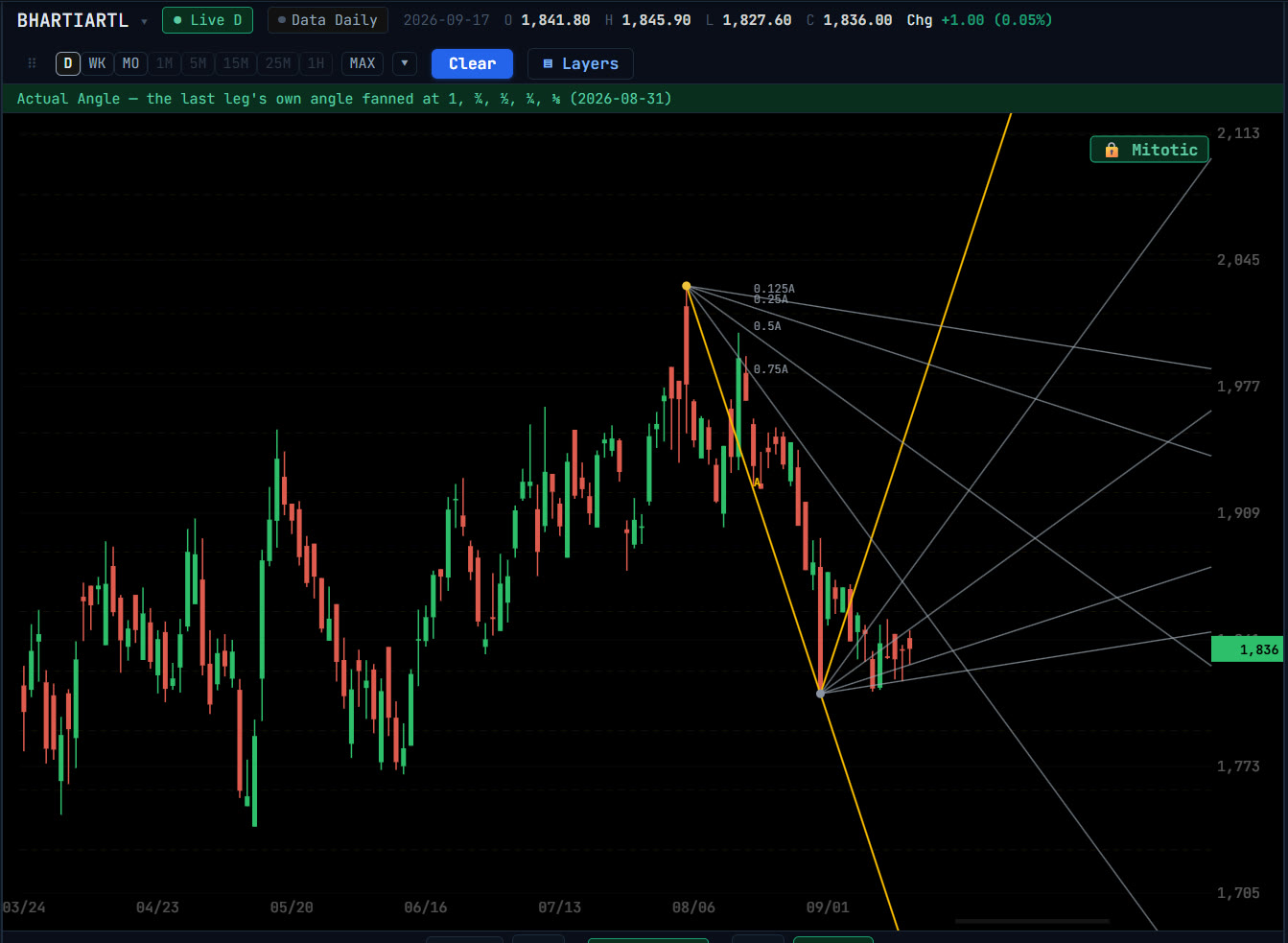
Why angles need a fixed scale
A Gann angle is a rate: so many units of price per unit of time. On a chart whose scale changes with zoom, the same angle is drawn at a different slope every time you look. Geometriya draws every angle on Mitotic Scaling, a fixed price-per-bar scale, so an angle keeps its meaning at any zoom and timeframe.
The tools
- Price to Angle
- Turns the price at a swing into an angle using a ratio you choose, and fires that angle and its 90° complement from the point. From a high the rays run down, from a low they run up.
- Actual Angle
- Uses a swing leg’s own slope instead of a fixed 45°, and fans it at 1, ¾, ½, ¼ and ⅛ of itself from the start of the leg, mirrored downward from its end.
- Zero Bouncing
- 45° angles reflected off the zero price line, in four variants carried over from the original Fortune+ tools.
- Secret Angle
- A construction from a swing low and the swing high after it. It draws angles whose crossings mark specific future dates, shown as white vertical lines.
Placing them
- 1Open Overlays and pick the tool from the Angles group.
- 2Click the swing it needs: one point for Price to Angle and Zero Bouncing, the two ends of the leg for Actual Angle, and the low then the high for the Secret Angle.
- 3Or press ⚡ on the row to anchor it on the latest confirmed swing automatically, and ◀ to step back to earlier swings.
Questions
What is the difference between Actual Angle and a 45° angle?
A 45° angle uses a fixed rate of one unit of price per unit of time. Actual Angle takes the rate the market itself travelled on a swing, then divides it, so the lines reflect that stock’s own pace.
Is the Secret Angle the same as a Gann fan?
No. A fan fires fixed ratios from one point. The Secret Angle is built from a low and a high together and is read for the dates its lines point at, rather than for price levels.
Do these tools place trades?
No. Geometriya is an analysis and paper-trading tool; no real orders are placed.